HOME | DD
Avapithecus — Minerva

#mythology #ancient #character #design #etruscan #goddess #minerva #referencesheet #roman
Published: 2025-11-18 15:40:12 +0000 UTC; Views: 8355; Favourites: 84; Downloads: 3
Redirect to original
Description
Uuuugggggghhhh I've been dreading this day, but it's finally time: I have to take a crack at Etruscan mythology today. “But Ava the Etruscans are super cool and underrepresented!” Yes, yes they are, but there's a recurring problem across Etruscan studies that keeps their lore out of general public consciousness: we have painfully little by way of an Etruscan corpus to study. We know their language, but that doesn't actually help. The Etruscans, much like the modern Basques, were a Pre-Indo-European people. They were the people indigenous to the European continent before the common ancestors to all modern “European” languages showed up from the Eurasian Steppe with new-fangled domesticated horses circa 2000 BCE. So far as anyone can tell, the precious few Etruscan inscriptions left behind in the archaeological record bear absolutely zero signs of being related to any other language, not to Latin, not to Greek, maybe to Basque and Linear A but there's some obvious sampling issues with proving that theory. There's no Etruscan Bible out there from which I can regale you with ancient myths of the goddess Menrva, for example, and even if there was, we'd have no related literature to compare authors’ intentions to. Etruscan mythology has largely crumbled into the forgotten sea, so all we really have is a best guess derived from archeological motifs. That is my challenge today. Fuck.
Minerva, admittedly, is an awful place to start for this, because if you try to Google the etymology of her name (rendered “Menrva”, “Merva”, or “Mera” by the Etruscans), you'll get a consistently Indo-European answer. The Proto-Italic name of this goddess was “*Menerwā”, ultimately descended from the Proto-Indo-European word “*ménwr̥” meaning “thought”. That smaller root “*men-” is a verb that means “to think” and is the common ancestor with the modern English word “mind”, which also gives us the names of the Greek goddess of memory, Mnemosyne, and one of Odin's ravens, Muninn (“mind” or “memory” interchangeably), whom the High One dreads losing above all else. One of Minerva's divine titles “Mensa” preserves an archaic Latin moon goddess “Meneswa”, which might suggest some intentional punning on “Menerwā”, but this too is an Indo-European root, making “Minerva Mensa” literally “Mindful of Measurement”, i.e. of the lunar calendar. Etymologically, this leaves us with the natural conclusion that the Etruscans borrowed their “Menrva” from the Italic Minerva, and not the other way around. The fact that we find the oldest archaeological evidence of Minerva only in Eturia however, and given that this material depicts scenes of Minerva which only the Etruscans seem to know by heart, frustrates this hypothesis with the suggestion of an indigenous origin (or at least the nugget of one) which we are woefully unequipped to dissect without more cohesive literature.
Normally, this is the sort of timeline we could resolve by simply looking at the oldest reference to a deity in the archaeological record, but here too Minerva's first appearance dates well after the Indo-Europeans first made contact with the locals. The temple at the Etruscan town of Pyrgi boasts bilingual inscriptions translating the indigenous tongue into Phoenician, dating back to circa 500 BCE, and it's only this late into the game that we first see Minerva's name written down. Pyrgi was a thriving port city which would've been no stranger to Hellenic colonists offering trade from Magna Graecia, so again, Minerva's first appearance here strongly suggests she was some import derived from the Greek goddess Athena, whom the Etruscans themselves heavily identified with Menrva. As early as 400 BCE, we see synchronism between Athena and Menrva emerge in the city of Arezzo, famous for its splendid bronze mirrors which in many ways are our clearest windows into Etruscan life and mythology.
These mirrors depict the classical motif of Athena being birthed from Zeus's head, just with the Greek names substituted for the Etruscan Menrva and her father Tinia. The Romans just sorta assumed Hesiod's version of the birth of Athena: Jupiter eats his fuck of the week, Metis, because prophesy warned him of a son he'd have by her who would usurp his throne like he did to his own father. Metis then proceeds to give birth to Minerva inside of Jupiter, and Jupiter develops such a ripping headache that he asks Vulcan to do him a solid and cleave his skull open. Minerva then emerges from the wound, fully grown and decked out in a complete suit of armor, and Jupiter relaxes his anxiety over the prophecy because Minerva is not, in fact, a son. How much this telling was assumed by the Etruscans is a little difficult to glean. Their equivalent to Vulcan, Sethlans, is depicted in these scenes, but he's not muscling Tinia's brain bones open. Instead, an exhausted Tinia is being tended to by Ethausva, Thalna, and Thanr, three goddesses of childbirth and midwifery who are often invoked in broader Etruscan society to protect expectant mothers during the single most dangerous period of their lives. The cadence of these images would seem to suggest that the Etruscans viewed the birth of Menrva not as a hostile daughter breaking free of a morally degenerate father, but rather as a welcome and expected emergence from the “womb” which was to be treated delicately by professional hands.
Or we're grasping at straws over literal items of vanity. This is again the problem with reconstructing Etruscan mythology, and at least here we have a well documented Greek core to build an interpretation off of. Several of these mirrors depict Menrva in situations we have flat out zero context for. One of the most prominent motifs, specifically from the town of Vulci, places at its center the infant Epiur, a son of Hercle (the Etruscan borrowing of Hercules) who is both a pudgy baby and a balding old codger at the same time. Epiur is often shown being trophied around to the rest of the pantheon before Hercle ultimately passes him off to his half-sister Menrva, all for unspecified reasons. Is this Menrva's kid too? Is she raising Epiur or just supervising him for the love goddess Turan, who always seems to be riding Menrva's rockin’ tits? Is this some kind of metaphor for successful education and child rearing? Does this have any correspondence with Menrva's triplet son Mariś, who is reborn thrice by being ritually boiled in some sort of giant crock pot? Fuck man, idk!
Menrva’s a goddess of wisdom and creativity just like Athena, we know that much. She's often depicted tittering gossip with Lasa Vecu, remembered by the Romans as the prophetess Vegoia, keeper and distributor of the secrets of Creation, but which mysteries she's imparting unto Menrva are rendered mute in art. Menvra also inherited Athena's warrior attributes, Etruscan pottery often showcasing a very specific scene wherein Menrva is hounding down the giant Akrathe with his own severed arm. Honestly, that's one story I prefer to have no context on, I think it's funnier that way. Martianus Capella meanwhile is kind enough to confirm Menrva is one of the nine Etruscan deities said to have control over lightning, which does line up with Etruscan art of her clutching Tinia's crackling spear in her fist, but he was writing in the 5th century CE, well after the last Etruscan was driven to extinction, so how much weight does that really carry? Unfortunately, this bag of unanswerables is all I really have to offer from what little we have of Etruscan primary sources about this goddess. The only path forward from here is to examine what character development the Romans gave her upon their adoption of her cult in 241 BCE.
Realistically, they'd known about Menrva since the days of Tarquin, but there wasn't a state institution of her worship until the Romans bulldozed over the city of Falerii. Falerii was a town smack on the border between Roman and Etruscan turf, and while its people were themselves Italic, they took sides with the Etruscans whenever the two big sharks in the tank got a little blood frenzied. Given how much of a pain in the ass it's been to dig up any information on the Etruscans, you can probably guess who ultimately came out on top in that pissing match. The Romans sacked Falerii and stole from their shrine on Mons Caelius a statue of Menrva, which was then paraded onto Aventine Hill as “Minerva Capta”, the Captive Minerva. Despite this admittedly derogatory name, the Romans would preserve Minerva's position amidst a triad of gods with Jupiter and Juno, a direct translation of Menrva's trinity with Tinia and Uni. Is this an indication that any Minerva-centered myths the Romans wrote down which have no parallel in the Hellenic Athena are in fact derived from an Etruscan original?
Ehhhh probably not? Pretty much all of the Minerva myths which aren't just a Roman reskin of Athena's lore comes to us courtesy of Ovid in the first century CE. Not only is that three centuries removed from Minerva's capture, but we're also talking about an author who was more concerned with contemporary political metaphor than mythological accuracy in the first place. Ovid had been banished from Rome in 8 CE by Emperor Augustus for being too raunchy with his poetry, and so Ovid decided to dedicate his entire profession as a writer to making all authority figures seem as crusty, pandering, and dictatorial as they in fact are, even the gods. This is how we end up with his variation of the Medusa myth in his Metamorphoses, wherein Medusa actually has some shred of sympathetic character development rather than just being a generic monster waiting for Perseus to come lob her head off. It's not much, mind you. Ovid's Medusa began life as a beautiful human woman, and we all know what happens to pretty little girls in Classical fairy tales. Out of all her suitors, it was Neptune who ultimately forced himself on Medusa, spitefully, in the middle of Minerva's temple no less. Minerva is purportedly so disgusted by this act, not because sexual assault is a blatantly evil crime which should never be done to anyone, but because sex is icky and somehow it's Medusa's fault for dressing like that. Minerva therefore punishes Medusa for desecrating her temple by turning the poor girl's beautiful hair into writhing snakes and cursing her with a gaze that turns men into stone. Luckily Ovid's message that powerful people use innocent peasants as toys to abuse and then sweep their victims under an apathetic rug, because they're above the law and what are you gonna do about it, has absolutely no relevance to modern society. Our system just works. Right guys?
Further along, in book 6 of Metamorphoses, Ovid uses Minerva again as a stand in for the powerful and influential who claim to love art and poetry until said art and poetry damages their fragile little egos. Arachne is a working class nobody from Lydia whose name is only known to broader society because she's a master weaver, her meticulously woven tapestries dyed with only the royallest Tyrian murex. Arachne loves her art, she's good at what she does, and she's spent her entire life cultivating this talent for no other reason than it is her passion and she wants to be the best at it. It's therefore really getting on her nerves that people keep telling her that her mastery of the weave was entirely a donation from Minerva, goddess of crafts. In a moment of exasperation, she tries to reason with an old woman who barged into her store demanding Arachne be more respectful of the gods who have been oh so generous as to allow her to make a business from her labors. “You think your advice is never heeded,” Arachne levels with this problematic customer, “that is my feeling too”. If Minerva is genuinely insulted by Arachne just living her life, then Minerva is free to come in here herself and challenge her to a duel on the loom.
The old woman then drops the gimmick and reveals herself to be Minerva, in the flesh here to challenge the girl's hubris. “Ahhhhhh fuck,” Arachne sighs, “I guess this is what I'm doing today”. The looms are strung and Minerva presents for the competition an intricate recreation of Olympus over Athens, Neptune pouting in time out after ceding the sapphire city to her namesake. It's a beautiful declaration of the unconquerable glory of the gods above Man, and the worst part about it is that it's less beautiful, objectively, than Arachne's weave. This lowly human girl spun from her fingers a tapestry of scorn and abuse, of the many birds worn by Jupiter to force heirs out of mortal wombs, of the snakes in Persephone's grasslands, and the misleading shepherd Apollo. It's brutal, it's honest, it's mankind's tortured soul incarnate, and even Minerva is unable to argue with the craftsmanship, so instead she just gets angry and tears the masterpiece to shreds right in front of Arachne's face. It's only after the heartbroken Arachne hangs herself that the red haze fades from Minerva's tunnel vision, too late. Minerva stands dumbfounded. Here she was, the goddess of wisdom, an intellect networked in eleven dimensions, lashing out with the sort of crude, base jealousy that takes an innocent human life. Maybe none of this was necessary, maybe it was Minerva's fault, maybe if it hadn't been so damn important to Minerva that she be visibly superior to every other sentient being beneath her, then it never would've reached this point to begin with. Yet a goddess Minerva is, and the best compromise her wounded pride can make with her indisputable guilt is to hoist Arachne by her broken neck and transform her into a dangling spider. Arachne may now spin her art freely for the rest of her days, and the yarn she produces will never again outshine Minerva's web. An equal transaction, right?
Much like this starving, unappreciated poet, however, Ovid did not craft his prose in a cultual vacuum. His other notable work, the Fasti, presents a more academic passion of explaining the Roman calendar and the origin stories of its many festivals. He describes one such holiday dedicated to Minerva, the Quinquatria, hosted from the 19th of March to the 23rd. March 19th was supposedly Minerva's birthday, and though she is a war goddess, she also represents the wits to end wars, so sword fighting of any sort was decreed illegal during those first 24 hours. That bullshit was cut the second the next sun rose, however, as all of Rome erupted into a fanfare of gladiatorial battles and raucous bloodshed to celebrate the hammer-nail approach we all know she's got secretly repressed in that violent heart. Ovid cites this as the ideal time for craftsmen, weaving women especially, to give thanks to Minerva. He also calls on schoolmasters to pray for the continued health of the educational institution, which Ovid refers to as “a tribe so often cheated of its pay”. Cough.
On the fifth day, called “Tubilustrium”, the ceremony is closed out with a grand parade and the blowing of war trumpets to get the boys in lorica segmentata pumped full of the adrenaline they'd need to go impose Minerva's worship on all the people who certainly hadn't asked to be conquered in the first place. This syncretism found the most success in Britain, specifically in what is today the city of Bath, named for the extensive baths the Romans constructed in 60 CE as part of a temple complex dedicated to “Sulis Minerva”. Sulis was originally a minor goddess from the Celtic pantheon, which of course means she is a can of worms for us reconstructionists to slam our heads repeatedly into. She's entirely local to Bath, save for one altar inscription unearthed in a Roman fort in Alzey, Germany, of all places, and her name derives from Proto-Celtic “*sūli-” meaning “sun” or “eye”, which would suggest she was some kind of sunlight deity, which admittedly makes sense to have as your patron in a spa resort.
How long exactly Sulis ruled over this singular location is one of those things that is just impossible to know. Geoffrey of Monmouth's genealogy (which if you've seen me rip my beautiful hair out over Arthurian historicity, you know is an incredibly funny joke in itself) regales us with an old yarn about how King Leir's father, Bladud, founded the first altar here roundabout the 9th century BCE after wallowing in local mud to cure his leprosy. It's one of those things that might as well be true. As far as I can tell, the Roman spa town was the first permanent settlement on land which is today Bath. Before that it was just sorta one of those shrines you pass by on a video game road to snag a free +1 to your constitution modifier for the next 20 minutes. Where she came from is really not important anyway, because her popularity is solely remembered today for its proximity to Minerva. The chucklefuck in me really just wants to highlight this episode in theological compression because it allows me to tell you about the Bath curse tablets.
These are approximately 130 lead tablets stamped with Roman HR complaints issued directly to Sulis Minerva, begging the goddess to punish the quickfingered parasites in this little den of thieves. Among such frightful insight to the sort of things testosterone makes you wish on your enemies, we find prayers that the goddess deprive the thieves of sleep, lobotomize their consciousness, switch their lungs and their liver, wow, or my personal favorite: “May your penis hurt when you make love”. That one's got me in stitches, like damn brother, that's such a diabolically low blow to request of a goddess. I love it, and I hope that son of a bitch got what he deserved. I'm sure you can still find graffiti of a similar philosophy all around Bath today, but they probably aren't dedications to Sulis Minerva. Bath had so thoroughly collapsed after the Roman withdrawal from the entire island in 410 CE that it's more famous today as the battleground that forged King Arthur. Minerva's original temple on Aventine Hill, meanwhile, had already fallen into disrepair and ruin by the time the Empire converted to Christianity in 313 CE. The ruins have never been identified and probably no longer exist, paved over after an unspecified amount of time to make way for the convent which now summits Aventine Hill in her stead. Whether or not Menrva is still held captive under the masonry of another god is a dungeon crawl I'll have to knit some other day.
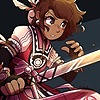
Design notes, lol notice how I understand how boobs work on the human body now. Minerva comes to me in the form of estrogen, and generously bestows her creativity onto this lowly human who is in no way arrogant enough to get herself turned into a spider for angering such an insurmountable force above nature as the extremely hot Minerva. Now that my statement on why Hellenic gods scare the shit out of me is legally noted for future record, there's a few historical depictions of Minerva that most caught my eye: the painting Minerva by 17th century artist Johan Silvius, a 3rd century BCE Etruscan original statue today known as the “Minerva of Arezzo”, the aforementioned mirrors, the rendition of Minerva on the Boccanera Plaques, and an engraving made by a court artist named Jan Muller circa 1600s. The 1600s objectively had the best fashion sense of any period in history, no wonder it was gonna help me design a goddess. There's also a bronze Etruscan figurine from the 6th century BCE seemingly posed to throw a spear which isn't in her hand anymore. I choose to believe this was an ancient pencil holder. I'm not sure what those drapes are but they remind me of Charnia fossils so that's how I tried to replicate them. That shield also was based on a Roman parade shield bearing Minerva's likeness. I just thought it looked cool with the aegis texture.
I say aegis, but I was really determined to make this a reference sheet of Minerva, not Athena. I do personally believe that Minerva is just an Etruscan transplant of the Greek Athena mythos with maybe an indigenous twist thrown on her, but the implications that has on the lore of the Drake Hero Universe still demands I create separate sheets as if they were two different characters. I wanted this to strike people as a more Italian, specifically Etruscan, goddess than you'd normally see the Hellenic Athena rendered as. I'm also extremely lazy and didn't want to tack on researching Athenian context on top of taking a pick at Etruscan academia just to see what falls out. I don't sleep well because I have chronic night terrors every night, and then I just go out into the day and acquire new trauma. I hope that Minerva, who was before called Merva and Mera and on and on, is satisfied that my mortal attempt is beautiful yet simultaneously incomparable to her own goddessly work at the weave, and that I will no longer have to be punished with an overactive imagination that won't turn off at night.


![fannd - [oc] Melvorin](https://skunkyart.darlopvil-hub.online/media/file/ed30a86b8c4ca887773594c2/f/47481bab-d400-4827-83ad-f819b0350f72/dmqf0wz-247027f1-2dea-4d79-99cb-9386b24ea9fc.jpg/v1/fit/w_1920,h_2546/_oc_melvorin_by_fannd_dmqf0wz.jpg?filename=_oc_melvorin_by_fannd_dmqf0wz.jpg&token=eyJ0eXAiOiJKV1QiLCJhbGciOiJIUzI1NiJ9.eyJzdWIiOiJ1cm46YXBwOjdlMGQxODg5ODIyNjQzNzNhNWYwZDQxNWVhMGQyNmUwIiwiaXNzIjoidXJuOmFwcDo3ZTBkMTg4OTgyMjY0MzczYTVmMGQ0MTVlYTBkMjZlMCIsIm9iaiI6W1t7ImhlaWdodCI6Ijw9MjU0NiIsInBhdGgiOiIvZi80NzQ4MWJhYi1kNDAwLTQ4MjctODNhZC1mODE5YjAzNTBmNzIvZG1xZjB3ei0yNDcwMjdmMS0yZGVhLTRkNzktOTljYi05Mzg2YjI0ZWE5ZmMuanBnIiwid2lkdGgiOiI8PTE5MjAifV1dLCJhdWQiOlsidXJuOnNlcnZpY2U6aW1hZ2Uub3BlcmF0aW9ucyJdfQ.cTceCxbMxbNWLyMWE1ZB6JYrSYYbA254ZhvZRg4Rh3I)


